
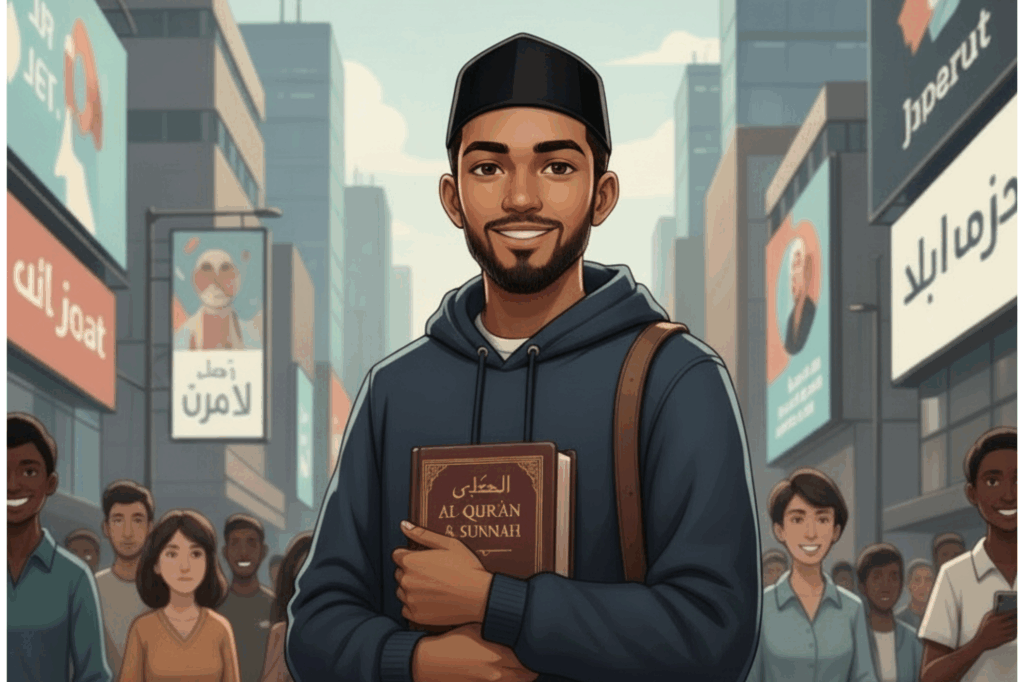
Feeling a sense of hesitation or embarrassment about your Muslim identity is often a natural reaction to the environment you are living in.
Many young Muslims grow up in a world where Islam is constantly misrepresented, linked to violence, backwardness, or extremism through media, politics, and selective narratives rather than the Qur’an and Sunnah. Over time, this creates subtle brainwashing: repeated messages that frame Western norms as “normal” and Islamic values as “problematic.”
When you’re surrounded by this at school, online, in movies, and in news, it’s natural to internalize some of that pressure.
- Fear of being judged: Avoiding religious terms or downplaying values to keep conversations from becoming “awkward.”
- The urge to fit in: Measuring your worth through external approval rather than internal conviction, like not wanting to wear hijab, going out for movies, mingling with the opposite gender, etc.
- Safety mechanism: Staying quiet about Islam, not because you don’t believe, but because you don’t want to be misunderstood or targeted.
This discomfort isn’t a reflection of Islam; it reflects the world’s misunderstanding of it. Islam was never intended to be an accessory worn only when it is socially convenient.
Prophet (saw) already told us about it. He said:
“Islam began as something strange and will go back to being strange, so glad tidings to the strangers.”
And the Qur’an also reminds us:
“But honor belongs to Allah, and to His Messenger, and to the believers.” (Qur’an 63:8)
Umar Ibn Khattab RA said, “We were the most humiliated people on earth, and Allah gave us honour through Islam. If we ever seek honour through anything else, Allah will humiliate us again.”
Before Islam, the Arabs were divided into tribes, engaged in endless feuds, burying daughters alive, and worshipping idols they carved with their own hands. When Islam came, it exposed Jahiliyyah to them first, its false gods, its moral chaos, its tribal arrogance, its worship of wealth and power. That was crucial. When ignorance is named and unmasked, it becomes impossible to romanticize. Once they saw how empty and degrading that world was, abandoning it was not a sacrifice; it was liberation.
The reason the stories of sahaba feel like “superhero movies” that could never happen now is simple: We are trying to carry the light of Islam without dropping the baggage of the world.
The Ṣaḥabah did not attempt a hybrid identity: part Islam, part tribal pride; part tawḥīd, part social norms; part obedience to Allah swt, part obedience to culture.
They understood what you struggle with – you cannot build truth on the foundations of falsehood.
Islam demanded a complete submission; it gave them vision, a life full of possibilities, moral clarity, and submission to something higher than tribe, ego or power. That inner transformation was what produced outward honour.
The “Moon” Logic
Think about it like a science experiment. The moon doesn’t have its own light—it’s just a rock in space. It only shines because it reflects the sun.
- As long as the moon is aligned with the sun, it glows.
- The moment it moves out of alignment, it goes dark.
The Muslim community is the same way. When we stay aligned with the “light” of Islam, we naturally shine. When we try to find our light by imitating influencers, chasing fame, or obsessing over status, the connection breaks. We aren’t losing the sun; we’re just moving out of its path.
When Arabs embraced Islam, they threw every concept, every value, and belief of jahilliyah from their lives. They left the fickle-minded world of oppression, humiliation, and worship of money. The light of Islam gave them the confidence and honour to rise above the created things to worship one and only Allah swt.
Islam did not merely teach them – it reconstructed how they thought.
- their idea of honor (from lineage to taqwā)
- power (from domination to responsibility)
- success (from wealth to accountability)
- freedom (from desire to servitude to Allah swt)
Why Do We Struggle Today?
The reason the stories of the Sahabah feel like “superhero movies” that could never happen now is simple: We are trying to carry the light of Islam without dropping the baggage of the world.
- We want the confidence of faith, but we’re scared of what people think.
- We want dignity from Allah swt, but we’re still begging for validation from society.
- We want to shine, but we’re standing behind a wall of trends and ego.
Their lives had a meaning now where every little act mattered; every soul had dignity, and every moment was connected to the pleasure of Allah swt. This is the axis of all honour. When a person stops bowing intellectually, emotionally, and socially to money, trends, race, power, or approval, they stand upright. And that uprightness made Sahaba great! not weapons, not wealth, but inner independence born out of servitude to Allah swt alone.
And for you too, the shift would happen through certainty of Imaan.
- Recognize that your feelings are a response to biased narratives being told umpteen times.
- Rebuild your foundation. Seek knowledge of the Qur’an. When you understand “why,” “how” becomes easier.
- Once you stop seeking approval from a world that doesn’t fully see you, let alone know you, the pressure to conform begins to lose its power.
Seek knowledge, acquire clarity on your faith, and reason it with clarity; your faith no longer becomes something you hide but the very source of your dignity and honour.