
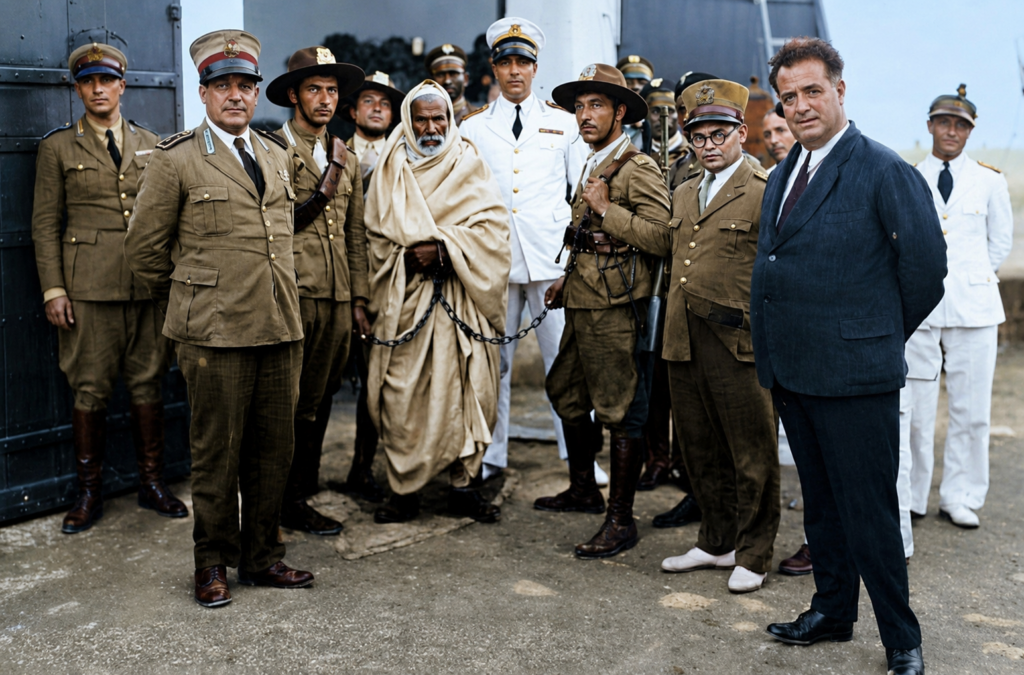
How would you deal if you were standing up to a massive bully who had way better gear, more resources, and a massive squad? No, this is no new survival game! We are talking about Omar al-Mukhtar, a Qur’an teacher who became one of the greatest guerrilla warfare legends in history.
The Setup: An Empire in Chaos
Back in the early 1900s, the Ottoman Empire (which controlled Libya at the time) was falling apart. Seeing their weakness, the Kingdom of Italy decided to make a move. In 1911, Italy declared war and invaded Libya’s coastline to build its own empire.
The Italians had modern military tech. They easily took major coastal cities like Tripoli, Tobruk, and Benghazi. To pressure the Ottomans even further, they bombed Beirut and took islands near Turkey.
The Ottomans, exhausted and weak, quickly signed a peace treaty after just one year and left Libya behind. The Italians thought they had won an easy victory. They were dead wrong.
Enter the Senussis: Desert Survivalists
While the Ottomans were packing up, a local group called the Senussi order was ready to stand its ground.
Decades earlier, a preacher named Muhammad ibn Ali al-Senussi started setting up zawiyas, which were religious schools that doubled as a religious and political movement. Over time, these students and teachers transformed into highly disciplined, self-sufficient desert survivalists.
When the Italians landed in Libya in 1911, Omar Mukhtar voluntarily joined the resistance movement.
THE MATCHUP
- Italian Army Vs Senussi Rebels
- Heavy artillery Vs Horseback & rifles
- Global superpower Vs Desert survival masters
- Unfamiliar territory Vs Home turf advantage
How a 50-Year-Old Qur’an Teacher Outplayed a Superpower
Omar al-Mukhtar was in his 50s when the fighting started, but he had the strategic mind of an elite gamer. He knew they couldn’t win a head-on battle, so he used guerrilla tactics:
- Hit-and-Run: His fighters would strike Italian outposts and vanish into the desert before the enemy could react.
- Sabotage: They cut communication lines and intercepted supply routes, leaving Italian troops stranded.
- The Desert Shield: While Italy controlled the coast, they couldn’t venture into the harsh, hot interior without getting completely picked apart.
By 1917, Italy was so worn down from World War I and Omar’s constant raids that they signed a peace deal. They actually recognized the Senussi’s control over most of Libya. It was a massive, historic win for the Muslims.
The Boss Fight: Fascism and Mussolini
The peace lasted five years. Then, in 1922, Benito Mussolini seized power in Italy, established a brutal fascist regime, and decided to crush the Libyan resistance once and for all.
Mussolini used modern, industrial warfare:
- The Divide: He used planes and vehicles to split Libya down the middle, trapping Omar’s cavalry in the east.
- Brutal Tactics: The Italian army began rounding up civilians, forcing over half the population of eastern Libya into concentration camps to cut off Omar’s food and support.
- Air Superiority: They bombed the rebels from above and even used chemical weapons.
Despite being outnumbered 33,000 to 6,000, Omar and his men bravely resisted and stood their ground for years. He remained steadfast and declared, “We do not surrender. We either win or die.”
The End of an Era
By 1931, the situation was critical. The rebels were starved, outgunned, and cornered. On September 11, 1931, during a fierce battle, a wounded, 73-year-old Omar al-Mukhtar was finally captured.
A few days later, he was sentenced to death and hanged.
Though he passed away, his legacy as the “Lion of the Desert” lived on. He showed the world that courage and strategy can keep even the most powerful empires at bay for decades.
What do you think? If you were in Omar’s shoes, facing an enemy with vastly superior technology, would you have negotiated earlier or shown the courage to fight until the end? What does his story tell us about the power of knowing your own “home-court” advantage?