
Ever felt like you’re getting mixed signals? You’re scrolling through TikTok or YouTube, and one scholar says a specific action is totally fine, while another says it’s not recommended. It’s confusing, right? If Islam is one truth, why aren’t all the rules the same?
Here is the secret: Differences of opinion aren’t an internal fault — they’re a feature which is indeed a mercy from Allah.
1. The Fundamentals: “No-Flex” Zone
First things first: there are some things scholars never argue about. These are called the Qataiyyaat (the absolute facts).
No one is going to tell you there are 6 daily prayers instead of 5.
No one is saying Ramadan is actually in December this year.
The core beliefs i.e. Imaan [Tawhid, the Quran (Books of Allah), the Prophets, the angels, the day of judgement and fate – the qadr of Allah ] are 100% agreed upon.
The differences only happen in the “fine print” — the specific details of how we apply rules to complex, real-world situations.
2. Why the Difference?
Think of the Qur’an as “Rulebook” and Sunnah as “Pro-Player Tutorial.” If the Quran covered every single tiny detail for every person until the end of time, the book would be billions of pages long. You’d never finish reading it!
Instead, Allah swt gave us a clear structure/general import and the intelligence to figure things out.
Back in the day when the Prophet ﷺ was alive, if the Sahaba had a question, they just asked him. Easy.
After he passed away, the Sahaba moved to different countries. Some remembered certain Ahadith that others hadn’t heard. Some interpreted the same words differently based on the situation in their new city.
The schools of thought are like schools of understanding the Qur’an and Sunnah. The imams strove to work out the rulings that they thought were closest to the Qur’an and Sunnah and there is nothing wrong with a Muslim following their Fiqh.
3. Real-Life Example: The “Banu Quraiza” episode
One time, the Prophet ﷺ told his companions: “Nobody should pray Asr until you reach the village of Banu Quraiza.”
On the way there, the sun started to set. The group split into two mindsets:
Team Literal: “He (SAW) said don’t pray until we get there. Even if the sun goes down, we wait.”
Team Context: “He (SAW) just wanted us to hurry up! He didn’t mean for us to actually miss the prayer time.”
When the Prophet ﷺ heard what happened, he didn’t tell either group they were wrong. Both were trying their best to follow him; they understood the “message” differently.
4. The Four Schools (The Madhabs)
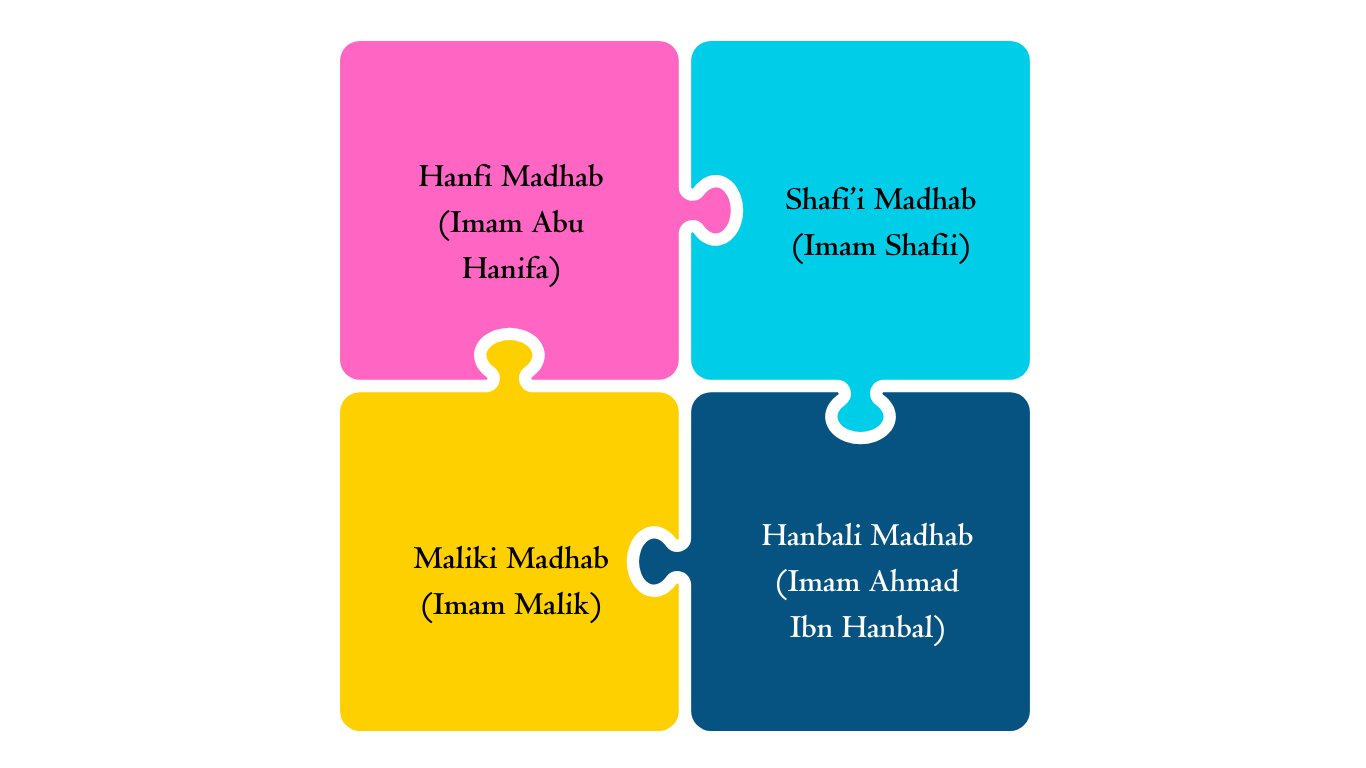
The four Imams, Imam Abu Hanifa, Imam Shafi’i, Imam Malik, and Imam Ahmad (May Allah have mercy on all of them) are like expert coaches. They created “Schools of Thought” to help us understand the Deen.
They didn’t make up their own rules. They gave us principles, or you may say formulas to derive the ruling in the light of Qur’an and Sunnah.
They used Usul al-Fiqh (the logic/science of law/principles of jurisprudence) to find the best evidence.
They were so sincere that the Prophet ﷺ said even if a scholar tries their hardest and makes a mistake, they still get a reward from Allah swt for their effort.
5. How to Handle It
You don’t need to be a Ph.D. in Arabic to be a good Muslim, but you shouldn’t just “wing it” based on your whims either. The point is not to base our actions on our whims or desires but to sincerely try to know the ruling of Allah SWT regarding every action and to follow that.
Ask the Experts: If you aren’t a scholar, it’s totally okay to follow a school of thought (Madhab). It’s like following a trusted study guide.
Check the Ego: Don’t get into comments-section wars. If someone follows a different (valid) opinion, don’t cancel them.
Stay Humble: If you find out a piece of evidence is super strong, be open to it. We follow the Truth, not just “our side.”
Allah swt gave us a religion that is flexible enough to work in 7th-century Arabia and 21st-century New York. Difference of opinion is a mercy — it shows Islam is built for everyone, everywhere. What’s one thing you’ve heard two different opinions on? Drop a comment (or just think about it) and try to look up the “why” behind those two perspectives today!
‘Understanding Ikhtilaf’ is nicely written piece elaborating real reasons for difference of opinion and humble reaction thereto. Ma Sha Allah. Keep it up. May Allah bestow more knowledge for correct interpretation and propagation of Islam and reward you accordingly both here and hereafter.