
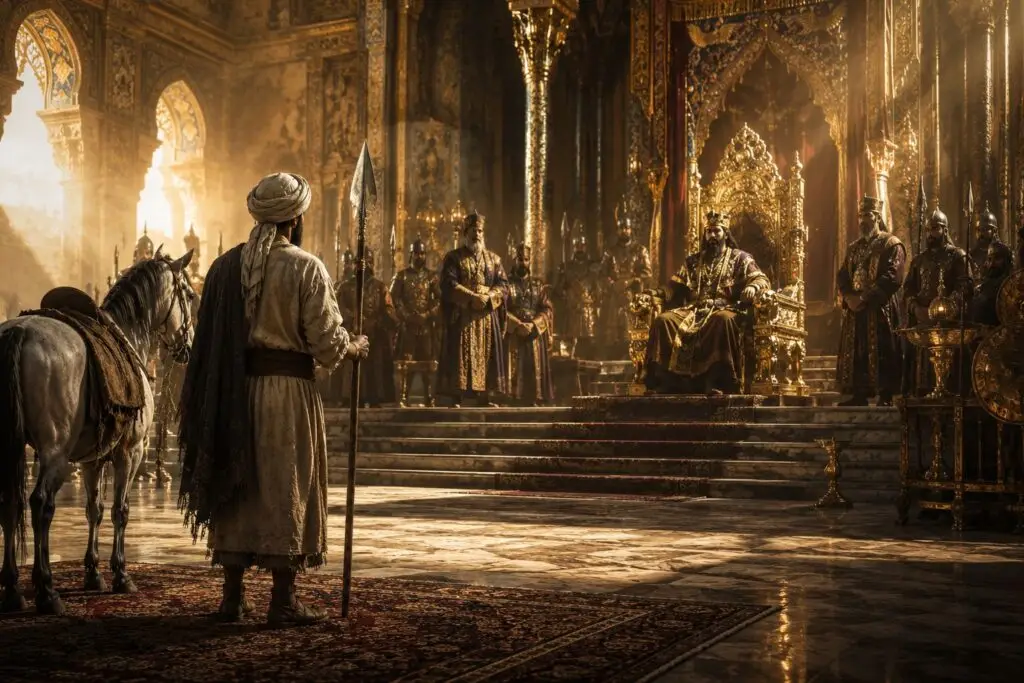
He walked into a king’s palace looking like a nobody. And he owned the room.
Imagine you’re invited to meet the most powerful person in the country. Everyone expects you to show up dressed to impress – best fit, maybe a driver, looking the part. Now, you roll up on a beat-up old bicycle, wearing your school uniform, and leave them speechless! That’s what happened 1,400 years ago, on a horse.
The Muslim Army vs. the Persian Empire.
Before the famous Battle of Qadisiyah (636 CE), one of the most decisive battles in Islamic history, the Muslim commander Sa’d ibn Abi Waqqas (RA) sent a representative to negotiate with Rustum, the top general of the Persian Empire. The man chosen? A companion of Prophet Muhammad (PBUH) named Rabiah Ibn Amir (RA).
The Contrast: What the Persians expected vs. what actually showed up.
• Persian Setup | • Rabiah’s (RA) Entrance
|
• Gold throne for Rustum | • Short, hairy horse
|
• Brocade robes threaded with gold | • Cheap, modest clothes
|
• Fancy carpets rolled out | • Sword wrapped in old cloth
|
• Royal guards lining the room
| • Spear blade tied on with fabric
|
• Expected a grand envoy
| • Zero guards or entourage
|
The Persian guards tried to stop him multiple times when he rode directly onto their expensive rugs without dismounting, when he tore apart two decorative pillows to tie his horse to, and he walked in armed, even though their protocol said weapons stay outside! Rabiah’s (RA) response was simple: I didn’t ask to come here. You invited me. Either let me in, or I’m leaving. They let him in every single time.
The Question: “Why are you here?”
This is the moment. Rustum, sitting on a literal gold throne surrounded by the trappings of the mightiest empire on earth at the time, asks this scruffily dressed man why Muslims have come to their land.
The Response: Clarity and Conviction
Rabiah Ibn Amir (RA) answered:
“Allah has sent us to deliver you from worshipping the creation to worshipping the Creator of the creation and to deliver you from the constriction of this world to the vastness of this world and the hereafter and from the oppression of religions to the justice of Islam.”
Think about what he said to a king sitting on a gold throne, surrounded by servants who bow to him: “You’re enslaved to things that can’t free you.” And that takes a different kind of confidence! No ego. No performance. Only clarity.
The Qur’anic Connection: Why this world is not the point
Rabiah (RA) wasn’t only making a political speech. He was communicating something the Prophet Muhammad (SAW) and the Qur’an had been teaching. The whole scene of the Persian throne, the gold, and the pomp was literally a visual of what the Qur’an warns about.
بَلْ تُؤْثِرُونَ الْحَيَاةَ الدُّنْيَا
“Nay, you prefer the life of this world” [Al-A’la 87:16]
وَالْآخِرَةُ خَيْرٌ وَأَبْقَى
“Though the Hereafter is better and more lasting“ [Al-A’la87:17]
The Prophet Muhammad (SAW) said: “Is not the world cursed and everything in it? Except for the remembrance of Allah and what facilitates it, the scholar and the seeker of knowledge.”
[Tirmidhi 2322]
The second sahabi came and sat on the throne
The next day, Mughira bin Shu’ba (RA) met Rustum, and seeing the throne was large enough, sat right next to him. The guards rushed over to pull him down. He stopped them:
“You are a people who worship each other. That is not how we Muslims treat one another; we treat each other as equals.”
The Ripple Effect: The battle was already won before the swords came out
Al-Tabari recorded something fascinating: the servants, soldiers, and lower-class Persians watching these exchanges were already thinking about Islam before the battle even started. The message of equality and dignity that no human should bow to another human had hit them where it must.
The Result
Muslims won the Battle of Qadisiyah decisively, despite being outnumbered by as much as 5:1 in some estimates. It marked the collapse of the Sassanid Persian Empire and opened Persia to Islam.
What’s the takeaway for you?
Rabiah Ibn Amir (RA) didn’t have the designer clothes, the entourage, or the impressive ride. He had conviction, and that walked into rooms before he did!
In a world where your worth gets judged by your followers, your fits, your gadgets, or your grades, there’s something radical about a person who is completely unbothered by all of it, because they know exactly who they are and why they’re here.
Think about one area of your life where you’re performing for an audience instead of living from conviction. What would it look like to just… stop?