
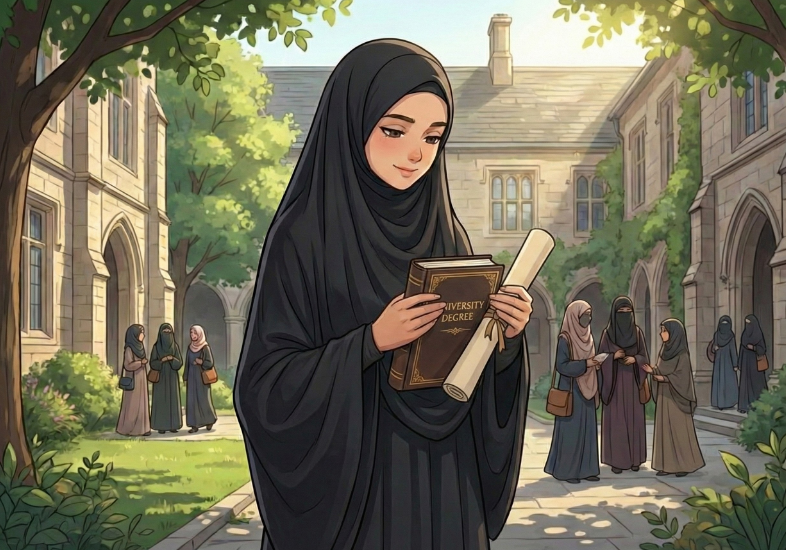
It seems everyone has an opinion on what you should wear, from school dress codes to the latest fashion trends. When your feed keeps pushing the idea that ‘modesty is a restriction’ or ‘inner beauty is the only thing that matters,’ it gets confusing. Some argue that Jilbaab (abaya) is not something tangible, but it’s about ‘lowering your gaze’ only!
Others go even further to the extent of saying Jilbaab isn’t mentioned in the Qur’an (spoiler: it actually is) or that it’s some “Arab Culture” thing.
While dressing up feels like a personal choice, for a Muslimah, there’s a specific “public life” look that isn’t about trends but Hukm (command) of Allah SWT.
Lately, the way Muslim women dress has been a huge talking point in the media. And the best way to handle the noise is to know the Dalaa’il (the evidence) behind why we do what we do.
However, the Qur’an explicitly mentions in Surah Al-Ahzab, verse 59
يَـٰٓأَيُّهَا ٱلنَّبِىُّ قُل لِّأَزْوَٰجِكَ وَبَنَاتِكَ وَنِسَآءِ ٱلْمُؤْمِنِينَ يُدْنِينَ عَلَيْهِنَّ مِن جَلَـٰبِيبِهِنَّ ۚ ذَٰلِكَ أَدْنَىٰٓ أَن يُعْرَفْنَ فَلَا يُؤْذَيْنَ ۗ وَكَانَ ٱللَّهُ غَفُورًۭا رَّحِيمًۭا
“O Prophet! Say to your wives and your daughters and the women of the faithful to draw their Jalabib (plural of Jilbaab) close around them; that is better that they will be recognized and not annoyed. And God is ever Forgiving, Merciful.”
In Islam, there’s a specific dress code for when you step out of your house and into public. It’s called the Jilbaab.
You might know about covering your Awrah (everything except face and hands), but in public, there’s an extra layer required. It’s sort of a “public uniform” that Allah SWT has prescribed.
Why wear it?
- Not a Culture Thing: It’s not a “tradition” or something your parents or society made up.
- Not a “Choice:” It’s a direct command from Allah SWT, just like praying Salah or fasting in the month of Ramadan.
- Submission: We wear it because we want to please Allah SWT.
What it’s NOT
A lot of people think that as long as you’re covered, you’re good. But according to Islamic law, certain outfits don’t count as the official “public dress,” even if they are modest:
- Long dresses/pants + Khimaar (headscarf): Still missing the Jilbaab layer.
- Shalwar Kameez: Cultural and modest but technically doesn’t replace the specific requirements of the Jilbaab.
The Jilbaab Checklist
What actually makes a Jilbaab a Jilbaab? It’s not a long shirt or a jumpsuit. Here are the specifications:
- The One-Piece Flow: It’s a loose, outer garment that drapes from the neck down to the feet.
- The Cover-Up: It goes over your normal clothes.
- No See-Through: It must be opaque (not transparent).
- No Hogging Limelight: It shouldn’t be Tabarruj (meant to attract attention or show off beauty to strangers). Like wearing bright colored or floral Jilbaab.
- The Length: It should be long enough to cover the feet. If you’re wearing shoes/socks, it should still reach the floor.
Everyday Heroes
When the verses about the Jilbaab and Khimaar (headscarf) were first revealed, the women of the Madinah didn’t wait for a style guide. They were ready to follow Allah SWT’s command that they literally tore their curtains to cover themselves immediately!
Today, there’s a lot of pressure to fit in or “modernize” the Deen. But staying firm on your identity is a major win in the eyes of Allah SWT.
A Family Project
This isn’t solely on the girls. Allah SWT tells the guys (husbands and fathers) that they have a responsibility to help their families stay on the right path. It’s about looking out for each other so the whole squad can make it to Jannah together.
“O you who believe! Save yourselves and your families from a fire whose fuel is men and stones…” [TMQ 66:6]
Next Step: Take a look at your “going out” wardrobe. Do you have a Jilbaab ready for your next trip to the mall or a walk in the park?